SAFIA


Ammonia stripping
≈ €5–7 per m³ [5]
Recovers nitrogen, but phosphorus and salinity are left untouched. Profitability depends on a cheap source of heat.
Regenerative water technology
SAFIA is a regenerative biofilter that turns the liquid digestate of biogas plants into reusable water and microalgae biofertiliser. It is built on three decades of ESA life-support research.
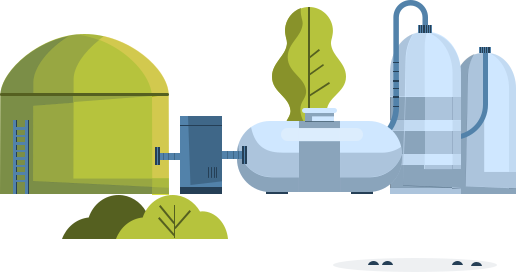
Water is too valuable to be treated as waste. Our vision is a world where every biogas plant returns clean water to the land, and the nutrients go back into the soil.
The problem
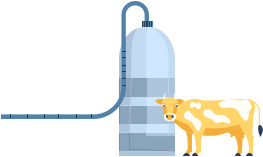
Biogas plants are multiplying across Europe and the world, and every plant produces digestate. Most of what goes into a digester comes back out as a wet, nutrient-heavy stream that operators have to manage within strict legal limits.
 Biomass
 Digesterabout 10% leaves as biogas
 Digestatemost of the input mass
 Solid–liquid separator
 Liquid fractionwhere SAFIA works
 Solid fractioncomposting
Today's options
≈ €5–7 per m³ [5]
Recovers nitrogen, but phosphorus and salinity are left untouched. Profitability depends on a cheap source of heat.
≈ €4–12 per m³ [6]
Produces clean permeate, but the contaminants are only concentrated into a brine, not eliminated. Membranes foul and need constant upkeep.
≈ €1–4 per m³ near the plant, rising steeply with distance [7]
Limited by available farmland and, in Nitrate Vulnerable Zones, by the 170 kg N/ha per year cap of the EU Nitrates Directive [8].
The SAFIA technology
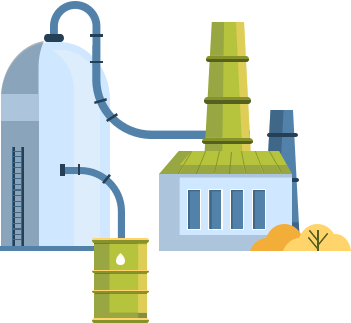
SAFIA treats the liquid fraction in a closed biological loop. Each reactor hosts a different community of microorganisms, and each one feeds the next. Gases are recycled inside the loop, and a digital twin keeps the whole system in balance.
Liquid fraction
 R1
Bacteria break down the organic load and release CO₂.
 R2
Biofilms convert toxic ammonium into nitrate.
 R3
Microalgae take up nitrate, phosphate and CO₂, and release O₂.
 Clean waterTargeting about 95% water recovery for agricultural reuse
 Microalgae biofertiliserNutrients recovered as a bio-based product
Space heritage
MELiSSA (Micro-Ecological Life Support System Alternative) is the European Space Agency's closed-loop life-support project, which started in 1989. More than 30 organisations from 10 countries have spent over three decades learning to recycle waste, water and air with chains of microorganisms, so that astronauts on long missions can live off a closed loop [9].
SAFIA brings that compartment logic down to Earth. It pairs bacterial and microalgae reactors in a regenerative loop, applied to one of the biggest liquid waste streams of the energy transition.
MELiSSA-derived technology already treats more than 1.8 million m³ of water a day worldwide, according to ESA [10].
Business model
We work with biogas and biomethane plant operators who need to manage their wastewater. SAFIA turns that cost into two recoverable resources.
Process water fit for agricultural reuse, at a time when Europe is setting quality rules for water reuse (Regulation (EU) 2020/741) [11].
Roadmap
Core technical architecture, reactor start-up, and training of the biological digital twin.
Full system assembly and rigorous testing for stability and reliability.
Validation in a relevant operational environment and preparation for market entry.
State of the art
Microalgae grown on digestate, nitrifying pretreatment and digital twins have each been shown to work separately. SAFIA's contribution is to combine them in one regenerative, controlled loop.
Stripping and struvite are mature; microalgae-based recovery is the emerging route.
Zielińska & BułkowskaLong-term outdoor operation, with treatment savings of about €3.4 per m³ of digestate.
Rossi, Mantovani, Marazzi, Mezzanotte, FicaraCutting ammonium by 95% made pilot photobioreactor cultivation possible. Ammonium control is the key step, and it is what SAFIA's R2 does.
Leca et al.A framework for using digital twins to monitor and control algae systems, including wastewater cases.
Sheik et al.Fouling and cost still limit full-scale membrane treatment of digestate.
Zielińska & BułkowskaHow ESA's closed-loop life-support research already reaches water treatment on Earth.
European Space AgencyEcosystem
SEMiLLA IPStar is a partner in the MELiSSA consortium. It looks after commercial applications of MELiSSA technology on Earth, working with the partners who developed each technology to turn it into products, pilots and companies in water, nutrients, food and circularity assessment.
 Algae biotechnology collaborative laboratory
 Systems, computing and control research
 Industrial-scale microalgae production
 Process engineering, environment and biotechnology
Get in touch
Investors, biogas operators, research partners and journalists are all welcome. Tell us who you are and we'll get back to you.